


Act now or fall behind: Why your marketing campaigns need consent management today!


You are in safe hands. Our team was rated 5.0 / 5.0 based on ratings collected via Google, Facebook, and Trustpilot.
We offer complete Google Ads campaign management services: We set up, maintain and optimize your campaigns. This includes creating all the landing pages for your ads if needed, ensuring that everything on your website is properly linked, linking your ads to our analytics dashboard, and directing the "leads" to the right place.

Trusted by over 100+ businesses!

Google Ads pay-per-click (PPC) advertising is one of the fastest and most cost-effective ways to instantly increase revenue or customers. It works by sending extremely relevant potential customers and customers to your website who are willing to pay for your services or products.
Why should your business use Google Ads?
Google Ads has the most sophisticated paid search platform and strongly outperforms all its competitors. Google Ads allows advertisers to set a daily budget for each campaign and select bids for each ad group and keyword. Campaign settings include features such as ad schedules, location settings, and mobile settings. In addition, the ad keyword planner allows you to research and evaluate the strength of the keywords for your campaigns.
How does Google Ads work?
Once a user performs a Google search, PPC ads are the first to appear. These are prominent ads that appear above organic search results and are always labeled "Ad." PPC ads allow businesses and organizations of any size to maximize online exposure, keeping in mind that Google is one of the largest search engines in the world.
More visits
and potential clients
Google Ads strives to be relevant and rewards advertisers who make their campaigns as useful as possible to those who search. Google assigns a Quality Score to each keyword in your account. Quality Score partially determines the cost-per-click for an ad in the top position in Google search. By optimizing the relevance of your ads and landing page content, our PPC experts can improve your account's Quality Score - allowing you to receive the most relevant visits. It’s also important to note that Google Ads (AdWords) favors advertisers who often customize their accounts and experiment with the latest features that Google Ads offers, making PPC management an essential element of advertising on Google Ads.
The best return
on investment
We are not interested in wasting money. Instead, we want to get the best return on investment. 95% of the companies and organizations we audit spend excessively every month and do not properly monitor their campaigns or do not monitor important indicators. Our team will work hard to get your ads displayed when potential customers are looking for your products and/or services.
What if you have low budgets?
Budget allocation is very important in all campaigns and any type of marketing. If you think to start advertising with low budgets (<400 €) it is very important to set all the necessary parameters in the right way, optimize the website itself and focus on priority products or services, depending on what you offer. If you have multiple goals, you must understand that in this way the budget will be halved, and in that case, each sub-campaign will be viewed separately. In any case, SEO website optimization is very important and one of the long-term solutions of the competition on Google.
Marketing, sales, and branding
It is necessary to understand the difference between marketing and sales. Marketing brings potential customers to your doorstep, a well-optimized website or team of sellers in charge of sales and branding is what turns every customer into a regular customer. To reap the greatest benefit, the growth of new and regular customers must be your priority. Check out advertising on social networks too!
Sending traffic to your website is only 50% of the work required to achieve the best conversion rate. The pages we promote with Google Ads need compelling content, engaging visuals, and a user-friendly experience, especially on smartphones. Our creative team of interactive web designers and developers can help you create highly optimized landing pages that fully meet all of the above requirements.
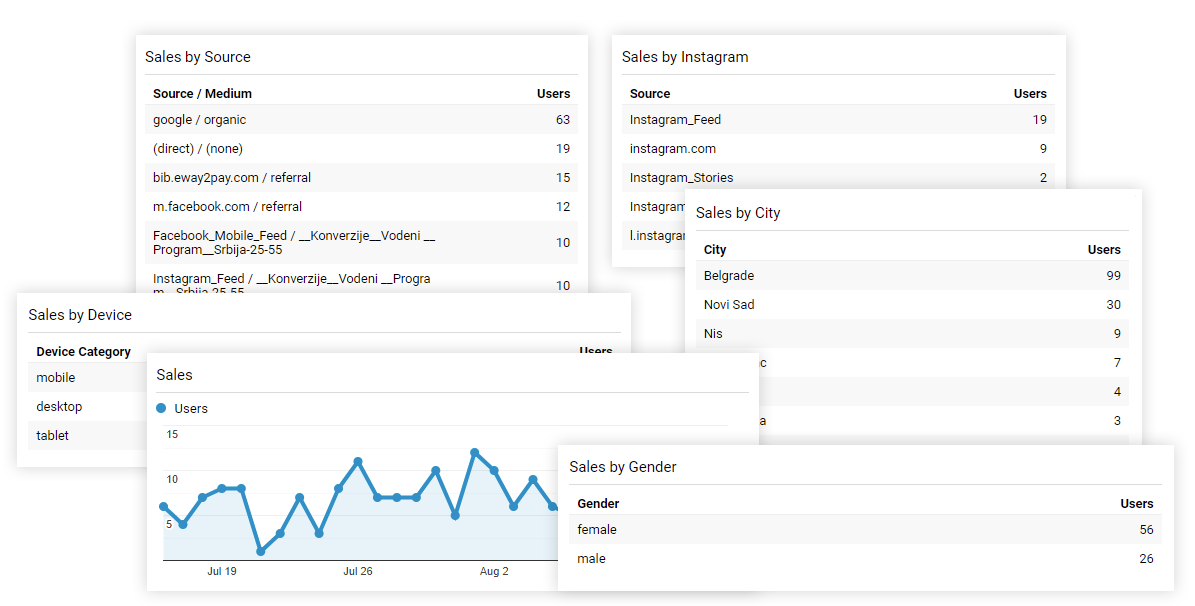
We also track all conversions in Google Analytics, where we set up special tracking for your website only.


Google Ads can be a minefield if you are unfamiliar with this platform. There are so many settings and variables to consider when creating and optimizing campaigns that you can easily spend your budget the wrong way if you decide to create your campaigns yourself. We think it would be useful to summarize some of the key things that should and should not be done. This should give you some strong foundations so that you can be familiar with the terminology and the process of building and increasing profitable campaigns.
Planning (strategy) of each campaign before starting the setup process. You need to think about what needs to be achieved (campaign goal), the keywords that will be used, and the marketing messages for the ad texts.
With Google Keyword Planner and other tools, you'll need to find your keywords and plan your budget. These tools are real indicators of which keywords are likely to generate the most traffic and have the least competition.
Setting up (and then testing) and tracking conversions is very important to know if your campaigns are working. The conversion can be different but it will probably be either a potential customer, a sale, or a phone call.
Regularly check reports and analytics to identify the terms people use to find your ads and to add or remove them (add negatives) to improve your campaign.
Negative keywords can play a large role in campaign performance. For example, to eliminate people who are just researching (not ready to buy), we can add words like "compare," or "review" as negative keywords.
Set up retargeting to target people who have already been to your website. Only a small percentage of visitors will buy something on their first visit, so here you can sometimes lose out on sales if you don’t attract the same visitors.
Our certified advertising experts have optimized and managed over 300 campaigns in the last 5 years.
A marketing professional assigned to take care of your account will schedule at least one phone call per week to keep you up to date with your campaign. Monthly Google Ads reports are standard in our agency, but you can always request additional reports. Contact your Google Ads marketing specialist and make sure everything is the way you want it to be.
Avoid broad-matched or generic keywords, as this will attract a lot of irrelevant traffic and cause unnecessary costs.
Traffic should not lead to the home page. Instead, traffic is directed to specific pages related to the keywords we are bidding on. This will help us improve our Quality Score, campaign performance, and save money.
We will not neglect landing pages - landing page relevance and user experience play an important role in assessing campaign quality and can affect campaign success. The speed of loading the page, placing keywords in the content, and of course... a lot of quality content!
It's not a good idea to use too many punctuations or capitalization in your ads because they won't be approved. We need to be aware of the limitations and guidelines that Google itself offers us.
Constant check every week. Depending on the size of your account, we will have to perform a daily check, although for many accounts 2-3 times a week is enough.
In short, it is important to have an insight into everything. We hope this list of things you should and shouldn't do more closely describes our part of the job and how campaign quality is maintained so we can discuss it together at some point.

Do you have questions for us?
Contact usBoth platforms can have a big impact on recruiting and bringing in new customers but they are very different fundamentally.
A user who came to your website via Google Ads was looking for a specific service or product at that time. By responding to that request, your website appeared in the search results as a paid advertisement, and you responded directly to that request.
Ads on Facebook and Instagram work differently. You are the one who is looking for customers by creating campaigns, announcements, and other actions, even though they may not be looking for you at that moment. Many go to social networks to just kill time and are not in the mood for any offers.
Of course, remarketing helps you a lot in this, to the extent that your ads may appear to someone within a few seconds of looking at a service or product that you, or others like you, offer.
Unfortunately, there is no way to determine exactly how much your competition invests in Google Ads.
In 2012, Google modified a broad keyword in 3 ways:
More keywords work so if you add the keyword "sneakers + running," Google will also show your ad for searches like "best sneakers," "best running shoes," "running tips", etc.
Although this functionality has changed over the years, many accuse it of squandering the budget. Of course, we always suggest the most precise targeting through accurate phrases and search that suits your business.
Page load speed does not directly affect the quality of your ad optimization or SEO, but if the website loads slowly and users in large numbers leave the page or website quickly, Google will know that the quality of that page is unsatisfactory and will want to provide users with a better alternative.
To become a Google Partner, you must meet several requirements:
- The agency must meet the conditions for optimizing campaigns and running them.
- The total budget on all orders in the last 90 days must be higher than $ 10,000.
- It is necessary to pass an online test.
If your campaigns fail to spend the allocated daily or monthly budget, the reasons may be as follows:
- Google Ads ads are displayed to users but are not attractive enough, and a small number of users click on them.
- Your campaigns are reaching their maximum. Check the size of your audience or expand your search so that more people can see your ad
If you need help with advertising, contact us.
Over 83% of Google's revenue comes from ads, so it is very important that everyone who advertises and invests in such ads is satisfied. Rotating your website's position on Google results is the standard way to show any ad so that all advertisers are satisfied and given an equal chance. Of course, the amount of one click and how much you are willing to pay for the same contributes to whether your ad will show in the top 3 positions and how often.
The answer to this question cannot be one or the other. SEO and Google Ads should be used in the best possible way, and this is just the case when you use both types of marketing channels.
Example 1:
If you're just starting or ranking your website isn't enough, Google Ads are here to help you rank your website. In this case, it is best to invest a sufficient budget in advertising, but also to work on improving SEO rankings.
Example 2:
If more users are coming organically, you can focus Google Ads on keywords for which you haven't optimized your website well. This way you won't miss out on any conversions.
The goal is certainly well-developed SEO, because this type of advertising is the most cost-effective in the long run, provides the highest value, and is reliable. You need to run Google Ads to the extent that they help organic search, and with good SEO this means minimal budgets that you can use elsewhere.
This is exactly the plan and strategy we develop with each client.
Ninety percent of our projects, cooperation with clients, are longer-term. Because of the way we work together and the results we achieve together, clients enjoy respect and we enjoy the trust they give us.
If you have several projects or you would like us to be in charge of various services, we can offer you discounts on services, but we certainly believe that you are on this website because you prefer quality and reliability rather than just reducing costs.
Although it depends on the industry, market, competition, and many other parameters, what we have noticed is that for Google advertising, a budget of at least 1000 EUR per month is a very good budget.
Why?
If you researched Google advertising in more detail, as well as advertising on social networks, you probably realized that Google, like Facebook, is a company that wants to make money, and all campaigns that last longer and have higher budgets have an advantage over other campaigns.
Google advertising is called an auction, and other advertising platforms operate on the same principle.
Given the market itself, the standards in our country, a budget of 1000 EUR and more have proven (in our case so far) as a budget you can rely on. This means that if you invest a smaller budget, each of your competitors with a larger investment will have an advantage over you and the results can vary a lot from month to month.
Of course, if you come from an industry where there are not many competitors or where the average budget is lower, then this budget is more than enough.
Smaller companies, start-ups, usually start with a budget of € 100, € 300, € 500 and gradually continue to increase their budget until the budget increase has no effect or if the return on investment (ROI) decreases to a level that is not desirable.
We are here to help you in this transition and we are the ones who make sure that you use your money in the best possible way.
You can always contact us and exchange experiences, ideas and consult with our team regarding your project and the cooperation itself.
As a Google Partner, our marketing agency offers you coupons (promo codes) for the first campaigns you create with us on Google.
Example of a coupon offered by Google:
Spend 100 EUR for a month, get 100 EUR.
If you sent us an inquiry, you have probably already received an offer in which you can notice that there are packages with a fixed and a percentage price concerning the budget itself. Of course, the packages are more framework agreements and facilitate the selection, but we certainly suggest an agreement and the creation of cooperation according to your activities, goals, and investment.
As we mentioned in the first part of this page, several different campaigns can be run. The frequency with which Google Ads are tracked also depends on your campaign duration, goals, and campaign budget, and tracking alone can vary from a few times a day to once every 2 or 3 days.
Keep in mind that campaign optimization is done in stages and that time, i.e. data collected, is a key detail in further improvement.
If you are already working with us, you have probably noticed that you have a folder in our office with your name and a multitude of reports, observations, and comments that help us in the work process.
If you are starting a new business, creating your first website, or embarking on online advertising and you are not sure how much money you should invest, there are a few things you need to know.
You must determine the criteria by which you calculate the return on investment. This depends on whether you are advertising services or products and on which platforms, channels, you want to advertise.
If you have an online store, the return on investment is calculated as follows:
Product ROI = (Revenue - Product cost price) / Product cost price) * 100%
If you advertise services, the return on investment is calculated as follows:
ROI = (Total Revenue - Total Cost) / Advertising Costs) * 100%
If you need to calculate more simply whether advertising pays off for you, you can do so by calculating the cost per acquisition.
The cost per acquisition is calculated as follows:
CPA = Campaign Cost / Sales
The cost per acquisition, CPA, should not be greater than the profit made by that same acquisition, otherwise, the campaign will not pay off for you.
Now that you know how to look at the most basic measurable values, we need to look at the process if you are advertising on multiple channels.
If you are just starting, you don't have a clearly defined budget allocation plan. In short, the more channels you have, your total investment must be divided.
In cooperation with you, based on the industry, previous experience, and based on mutual agreement, we determine the initial plan for the distribution of the budget by platforms. In addition to Google, most new brands are also advertised on social networks, so the same budget is distributed to bring the most results.
In the following period, mostly for a month, all advertising channels, in this case, the budgets of Google advertising, are monitored and corrected based on the results.
Monitoring analytics and optimizing campaigns is very important to get the return on investment as high as possible.
The goal of this test period is to determine the exact budget allocation by platform, product, or service and to plan a budget increase so that each channel, in this case, Google Ads, can be the most cost-effective.
ROI or return on investment is calculated in the following ways:
If you have an online store, the return on investment is calculated as follows:
Product ROI = (Revenue - Product cost price) / Product cost price) * 100%
If you advertise services, the return on investment is calculated as follows:
ROI = (Total Revenue - Total Cost) / Advertising Costs) * 100%
Paid search or "pay-per-click" (PPC) is a type of advertising that usually refers to sponsored results at the top of search engine results (SERP). These ads charge you for each click and can be set to appear only when certain keywords are searched so that your ads target a specific group of people who are interested in what you offer.
This type of ad can be extremely effective, as it relies on information obtained from the behavior of individuals online and is used to increase website traffic by displaying relevant ads to the right people at the right time. These ads also include retargeting, which means that depending on customer actions, marketing automation tools can create unique personal ads on multiple platforms.
The PPC ad network refers to a platform that can deliver your ads to users. Google Ads (formerly known as Google AdWords) is an example of such a network. If you intend to create PPC ads, you will use an ad network such as Google Ads, Facebook, or Microsoft Advertising.
These ad networks connect you with a diverse audience, as well as provide unique targeting options. Using Microsoft Advertising, for example, allows you to promote your business through Bing and sites linked and approved by Microsoft Advertising. Comparatively, Facebook gives you access to its vast user base.
Advertising spending is the budget of your ad network. It amounts to how much you're willing to spend on ad networks, whether in a year or a month.
In most cases, companies use advertising costs as their monthly budget. As an example, consider a company budget with a monthly ad spend of 5,000 USD:
With PPC advertising, you can create advertising spend that meets the needs of your business and audience. Whether you want to spend your entire ad spend on a single ad network, such as Google Ads, or multiple ad networks, you have complete control over it. If you are not sure where to invest (or even how much to spend), ask us.
We have managed a large number of PPC campaigns and can provide reasonable advice for your business.
The most popular PPC locations include:
When advertising online, you will mainly focus on certain platforms, such as:
If you are creating a PPC campaign, you want to focus your efforts on the most valuable channels for your business. For example, if your audience uses Facebook more than Twitter, you probably want to spend more on your Facebook advertising budget. Researching your audience, as well as surveying current customers, can help focus your PPC campaign on the platforms with the greatest potential.
Yes! The ads that appear in search results contribute more than 45% of clicks to the page.
Even better, people who click on ads are twice as likely to buy a product or service from an organic visitor or someone who visits your site without clicking on the ad. With PPC ads, you can reach people who want to buy, which can immediately affect your sales number. Not to mention, PPC ads also bring an average return on investment (ROI) of $2 for every dollar invested.
If you advertise with Google Ads, that amount increases to $8. People not only click on ads like this but often buy.
Pricing for a PPC ad campaign varies by business, industry, and strategy. Therefore, the average varies greatly and needs to be determined for each business individually.
The price includes your spending on ads, as well as additional costs, such as management services by the PPC agency.
With PPC, what you pay per click depends on several factors, including:
For the most cost-effective ads, focus on creating high-quality ads with reasonable offers. Before you run an ad campaign, think about your user experience. When people see your ads, for example, will it make them curious enough to click, and will your landing page meet that curiosity?
Choose an agency that values your budget. Working with an agency that doesn't treat your budget as their own can often lead to wasted advertising, high bids, and demands for even more advertising budget. Working with an agency like Creative Brackets can make your campaigns very profitable.
PPC ad advertising offers your business several market benefits, including:
The fact that PPC offers a large return on investment shows its usefulness in your online advertising strategy. If you want to improve your business, as well as compete with the biggest competitors, paid advertising can help you achieve those goals.
Any business can use PPC advertising. Some examples include:
A few searches about your products or services can reveal if this strategy is the one you need to have for your business. Even if you find zero ads in searches relevant to your business, that doesn't mean PPC isn't worth your company's time. If nothing else, it reveals a huge opportunity to take advantage of.
If you decide to work with a digital marketing agency for your advertising campaigns, make sure they have some experience in your business. An agency like Creative Brackets, for example, is a great example of an agency that probably has experience in your market, as it has managed a huge number of different campaigns.
PPC can work in several different ways, depending on your ad network and ad type. For example, although similar, Google Ads and Microsoft Advertising use different algorithms for their ad auctions.
When discussing how PPC advertising works, many refer to Google's process. So, if you're advertising on Google, you can expect the following:
During an ad auction, Google also calculates your cost-per-click using the following formula:
CPC = Ad Rank below you / Your Quality Score + $ 0.01
This formula is the reason why PPC consultants, as well as agencies, focus on creating high quality. If you create a useful ad, you can achieve a better Quality Score, which can lead to lower costs and improved ad rank.
Although more than 70% of companies don't check their campaigns for more than a month, they want to track their ads more often. For best results, paid advertising experts recommend weekly campaign reviews.
By comparison, brand new campaigns should be monitored on a daily basis. If you want to take a proactive approach to tracking your campaigns, but can't, Creative Brackets can help you in the following ways:
No matter how you work, frequent monitoring will help you create better campaigns. For example, if you notice a high clickthrough rate (CTR) but a low conversion rate from mobile users, you can remove them from your audience. You can also customize your landing page to provide a better mobile experience.
Either way, you can make instant changes to improve your campaign.
There are 26 discussions on this topic
Clients give us their trust in managing their accounts, so becoming a Google Partner was not a challenge for us, but a way to show clients that they made a good choice.
90%
The consumer says that ads influence their purchasing decisions
75%
users say paid search ads make it easier to find information
58%
millennials have bought something through online ads or social media
33%
people click on the ads because they think the ad is relevant to their search
22%
Baby Boomers bought something because of ads online or on social media